加群或其他问题可扫二维码添加阿瑟

加群或其他问题可扫二维码添加阿瑟

Compare Palau ID, Estonia e-Residency, and 7 digital nomad visa countries. Fees, limits, and why Palau starts at $288 online.

Signing up for an international app and getting stuck on identity verification? Or shopping for a second ID document — Palau ID, Estonia e-Residency, Spain’s digital nomad visa — they all sound like “overseas identity,” but they solve completely different problems.
You might be wondering:
If that sounds like your situation, this guide is for you. I’ll use two comparison tables (digital residency programs + 7-country digital nomad visas) to sort the categories, then focus on Palau digital residency — one of the lowest-barrier ways to get a physical digital identity ID card fully online. Step-by-step application details and screenshots are in our Palau ID application guide.
Most people aren’t confused about “which country is best.” They never figured out whether they’re applying for a digital identity ID, e-Residency, or an entry/residence visa.
“Overseas digital identity” sounds like one big bucket, but underneath are several unrelated tracks. Here are four common types — every comparison in this article builds on this table.
| Type | Typical example | What you actually get | What it usually does not give you |
|---|---|---|---|
| Digital residency ID | Palau ID (RNS.ID) | A sovereign-state digital identity ID card (including a physical card) | Citizenship, passport, general residency rights |
| e-Residency | Estonia e-Residency | EU digital ID card + e-signature + remote company formation | Schengen entry, local employment rights, automatic tax residency |
| Digital nomad visa (DNV) | Spain / Portugal / Croatia DNV | Legal residence + remote work permission in one country | Not a digital identity ID card; usually no hiring locally |
| Passport / citizenship | Naturalization programs | Full nationality | Extremely high bar — not what this article covers |
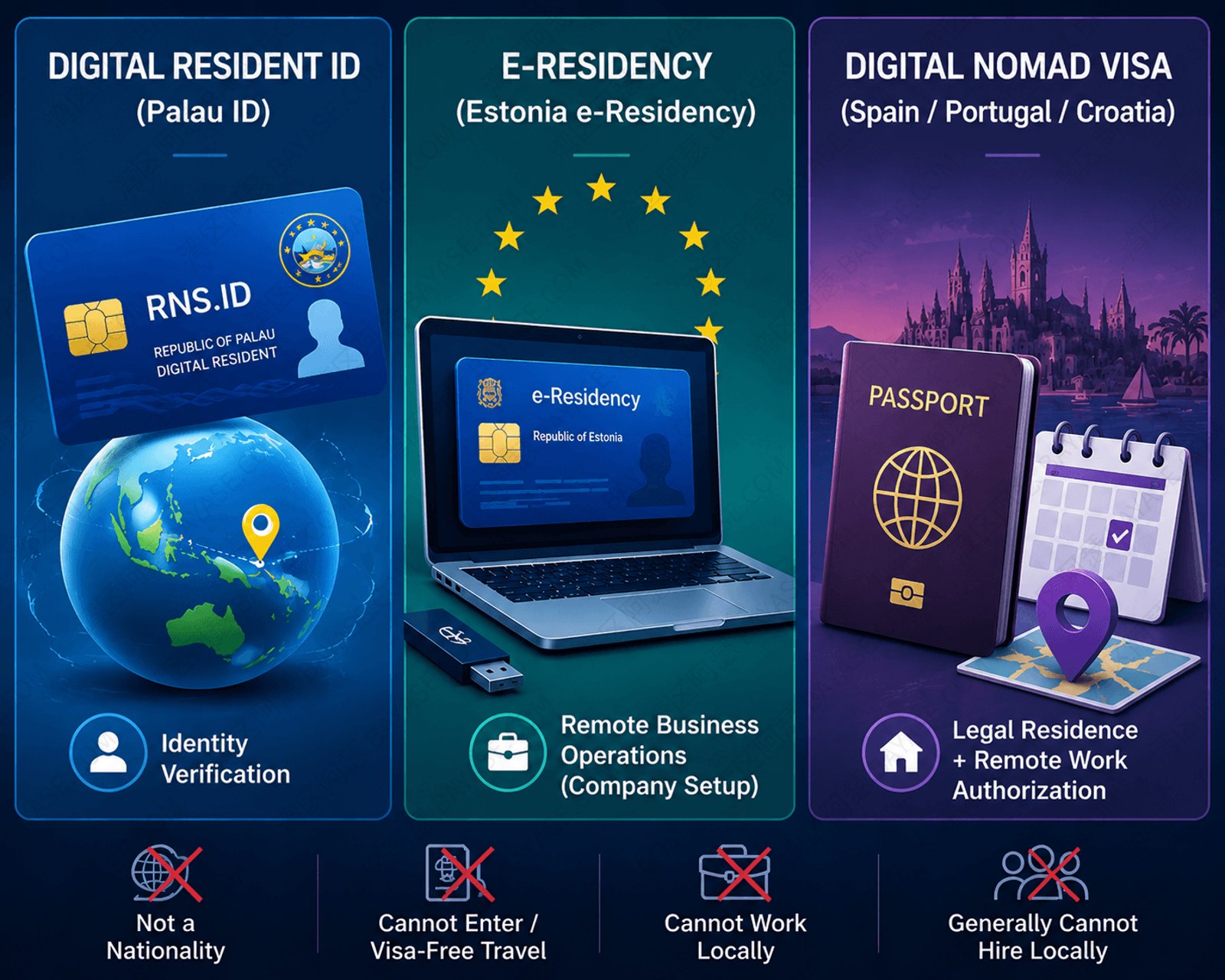
Key point: Palau ID is a “digital residency ID,” not a visa. Estonia is “e-Residency.” Spain and others are “digital nomad visas.” These three do not substitute for each other, and none of them equals immigration.
⚠️ Don’t fall for “one ID card = second citizenship.” Many people lump the first two categories under “digital citizen ID,” but the legal weight is worlds apart — match your goal to the right row before you apply.
Start with your use case, then pick a program. These five scenarios come up most often:
1. Overseas platform KYC / identity checks
Web3 and some international services ask for ID. Palau’s official site mentions KYC for fiat and crypto — but whether a platform accepts your document is a separate question. Mainstream exchanges’ stance on Palau ID is covered below and in the limitations table. Don’t rely on sales copy alone.
2. Day-to-day identity verification
Palau’s site lists check-in, boarding, car rental, and similar uses. Whether your card is accepted depends on the institution — there is no “works everywhere” guarantee.
3. Remote company formation / e-signature
That’s the core of Estonia e-Residency. Palau’s roadmap mentions E-corporations, but that’s not fully live yet (see Section 6.5).
4. Cross-border payments / banking
Estonia’s ecosystem is more mature (company + Wise Business paths). Palau still has low traditional-bank recognition; Digital Banking is on the official roadmap — don’t treat it as available today.
5. Digital nomad life
If you want to actually relocate and work remotely in a country for months, look at a digital nomad visa, not Palau ID. Palau ID may mention policies like “up to 180 days per entry” — that does not give you residency rights worldwide.
Once your scenario is clear, start with the digital residency comparison table.
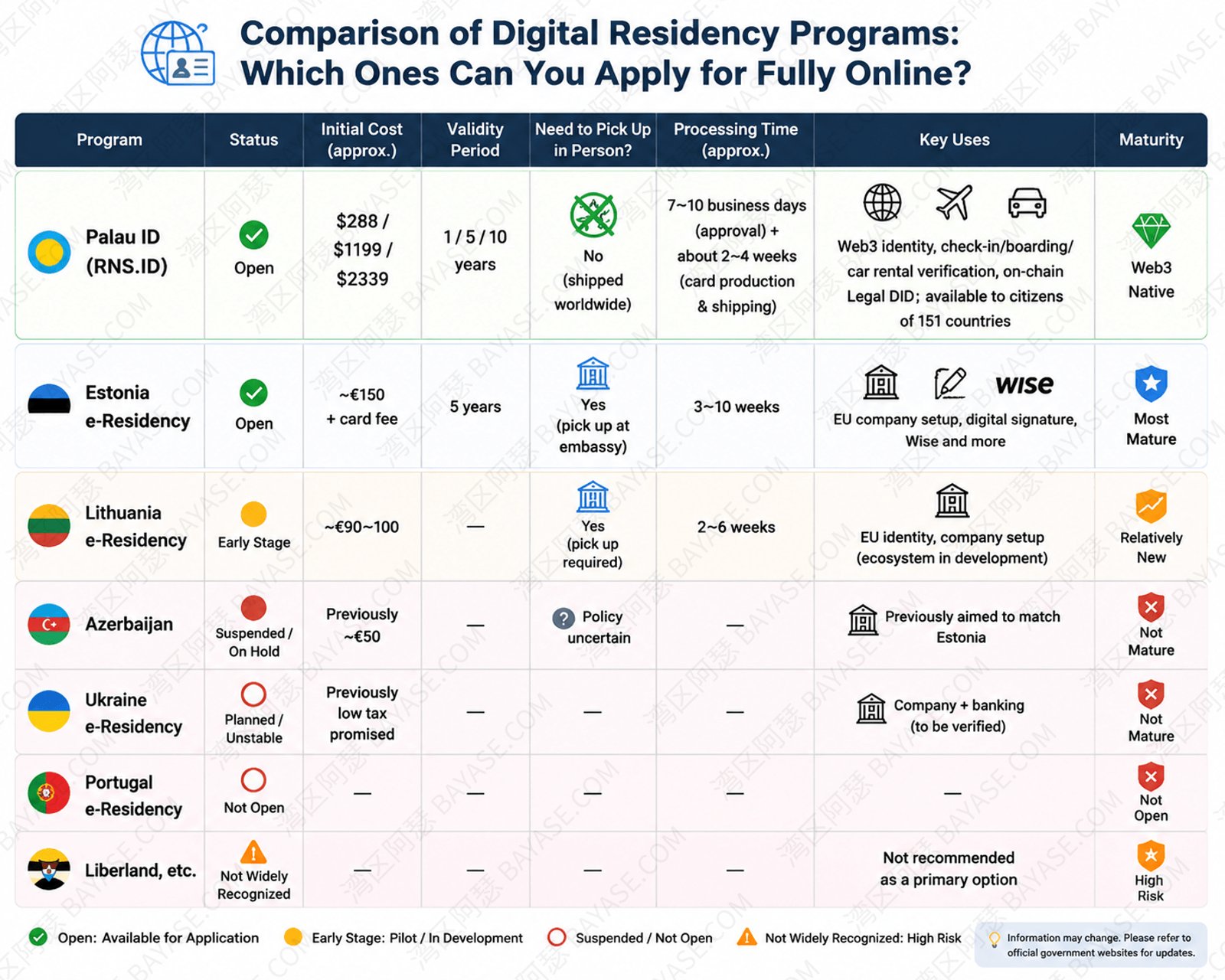
This table answers: without traveling, which “overseas identity” programs can you self-serve? I mark Palau as the top pick for online ID; Estonia as the mature benchmark.
| Program | Status | Initial cost | Validity | In-person card pickup? | Processing (approx.) | Main uses | Maturity |
|---|---|---|---|---|---|---|---|
| Palau ID (RNS.ID) | ✅ Open | $288 / $1199 / $2339 | 1 / 5 / 10 years | ❌ Physical card shipped globally | ~7–10 days review + ~2–4 weeks card mailing | Web3 ID, check-in/boarding/rental verification, on-chain Legal DID; citizens of 151 countries | Web3-native |
| Estonia e-Residency | ✅ Open | ~€150 + pickup fee | 5 years | ✅ Embassy/consulate pickup | 3–10 weeks | EU company, e-signature, Wise, etc. | Most mature |
| Lithuania e-Residency | 🟡 Early | ~€90–100 | — | ✅ Pickup required | 2–6 weeks | EU identity, companies (ecosystem growing) | Newer |
| Azerbaijan | 🔴 Paused/shelved | Was ~€50 | — | Policy-dependent | — | Once compared to Estonia | Immature |
| Ukraine e-Residency | 🔴 Planned/unstable | Low-tax marketing | — | — | — | Company + bank (verify) | Immature |
| Portugal e-Residency | 🔴 Not open | — | — | — | — | — | Not open |
| Liberland, etc. | ⚠️ Not widely recognized | — | — | — | — | Not recommended as primary | High risk |
Quick takeaways:
If you want a physical digital identity ID card without traveling, among programs that are still stable and relatively mature, Palau ID is almost the only path that is fully online with global card delivery.
If you need an EU company plus a legally recognized e-signature, Estonia e-Residency is still the benchmark — but plan a trip to a designated embassy/consulate to pick up the chip card.
Azerbaijan, Ukraine, Portugal, and others are paused, not open, or fast-changing. If you’re watching those, check each country’s official site — I may cover them separately later.
While researching, you may also see similar names, different categories — don’t mix them with the table above:
A digital nomad visa solves legal residence and remote work in one country, not “issue a digital ID card like Palau ID.” Below is a 7-country snapshot (income thresholds and fees vary — confirm with each immigration authority):
| Country | Monthly income (approx.) | Max stay / renewal | Typical total cost | Remote work only? | Tax notes | Best for |
|---|---|---|---|---|---|---|
| Spain | ~€2,760+ | Renewable up to 5 years | Consulate + insurance + docs (€ hundreds+) | ✅ Remote only | 183+ days may trigger tax residency | Long-term Europe, stable income |
| Portugal | ~€3,480+ | 2-year card, renewable | Similar + proof of funds | ✅ Remote only | NHR and similar policies tightening | Lisbon nomad community |
| Croatia | ~€3,295+ | 18 months (check official site) | ~€140 fees + | ✅ Remote only | Foreign-income tax claims need verification | Trial Europe, accept term limits |
| Greece | Medium (check site) | 1 year, renewable | — | ✅ | — | Mediterranean lifestyle |
| Thailand | Relatively lower | 1 year | — | ✅ | — | Cost-sensitive Southeast Asia |
| UAE (Dubai) | High income bar | 1 year | Higher | ✅ | — | High net worth, Middle East hub |
| Estonia DNV | Dedicated channel | Pairs with e-Residency | — | ✅ | — | Already on or planning e-Residency |
Honestly, visas usually require stable active income, insurance, clean record, housing contract — far above Palau ID starting at $288. No local gigs or hiring is typical (Spain enforces this strictly).
If you’re not planning to relocate soon, a digital nomad visa is often a worse first step than a self-service, online Palau digital identity ID card to test the waters. Country-specific documents and interviews — I’ll break those down in a follow-up; here the goal is picking the right direction.
Estonia e-Residency has been the “national digital identity” reference since 2014. I’m not pushing you to apply — this section clarifies how it differs from Palau.
| Factor | Estonia e-Residency | Palau ID |
|---|---|---|
| Application | Online | Online |
| Card delivery | Pick up chip card at embassy/consulate | Mailed to you |
| Cost | ~€150 + pickup fee | From $288/year (RNS.ID list price) |
| Main use | EU startups, e-signature | Personal digital ID, Web3, physical digital identity ID card |
EU company → Estonia e-Residency (embassy pickup required). Lowest-barrier physical digital identity ID card without travel → see Palau below.
If you’re still reading, you probably want a self-service overseas identity without flying to an embassy. Palau digital residency (Palau ID / RNS.ID) is what I’d suggest for beginners to try first — if you accept its limits (limitation table below).
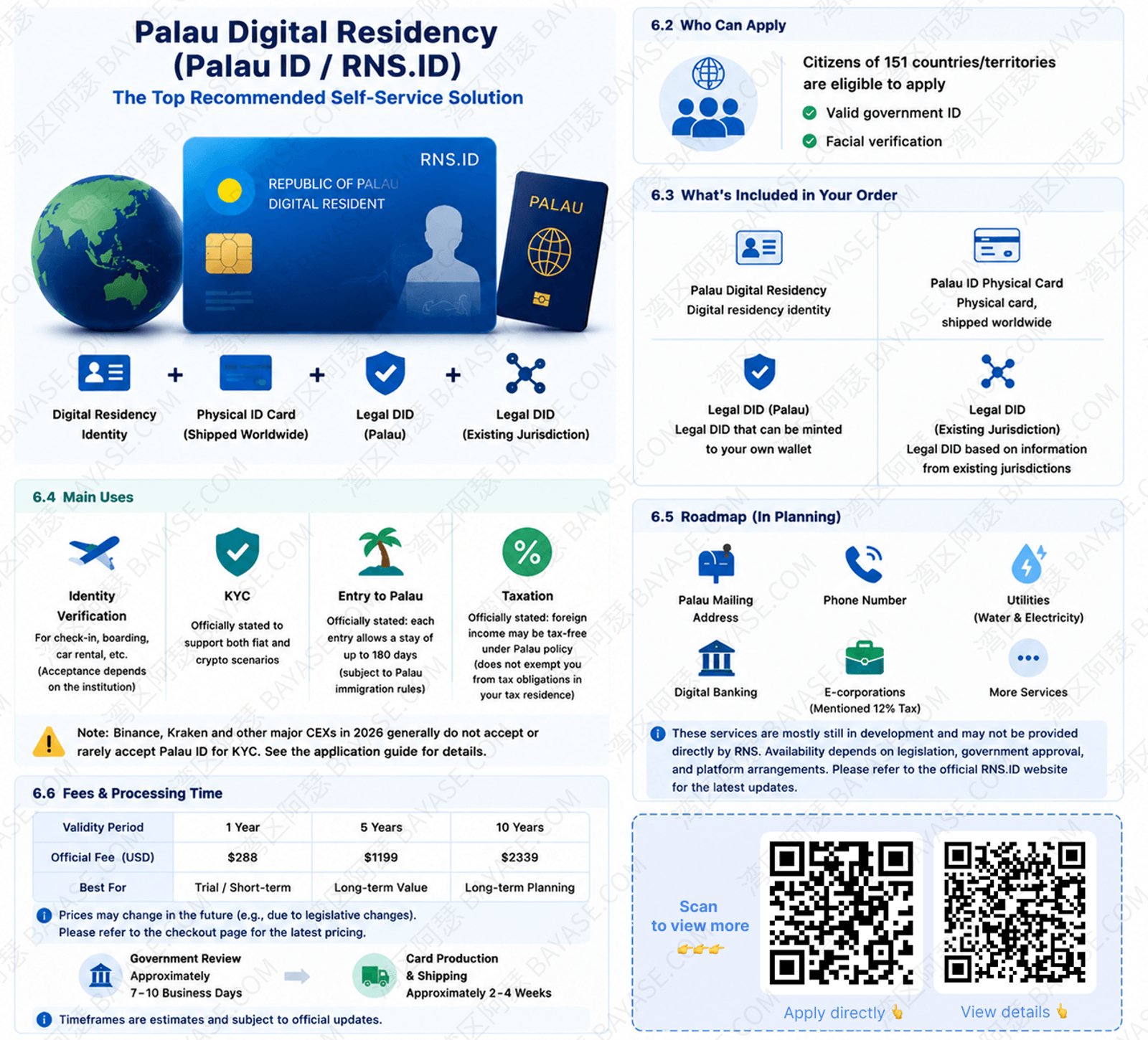
Palau Digital Residency runs on RNS.ID, marketed as Sovereignty-Backed Web3 ID — a Web3 identity backed by a sovereign state. It’s government-issued proof of identity for scenarios that require legal ID; it is not citizenship, a passport, or a visa.
What you typically get: digital residency status + a physical Palau digital identity ID card shipped worldwide + optional Legal DID minted to your wallet (Palau-jurisdiction DID and Existing Jurisdiction DID). That’s different from “Estonia chip card only, no on-chain DID.”
The official site lists 151 countries/regions (restricted list subject to RNS review). Usually: valid government ID + face verification — no investment or language test.
| Item | Description |
|---|---|
| Palau Digital Residency | Digital residency status |
| Palau ID Physical Card | Physical card, global shipping |
| Legal DID (Palau) | Legal DID you can mint to a wallet you choose |
| Legal DID (Existing Jurisdiction) | Legal DID based on your existing jurisdiction info |
⚠️ Important limitation: As of 2026, major CEXs like Binance and Kraken generally do not accept — or only inconsistently accept — Palau ID for KYC. That’s separate from paying Palau ID fees with USDT on the official site. Full limits are in our Palau ID application guide limitation section.
The official Digital Residency Roadmap mentions Palau mailing address, phone, utilities, Digital Banking, E-corporations (including 12% tax messaging), and more.
Most of this is still in progress; some services may not be delivered by RNS directly. Launch depends on legislation, government approval, and platform rollout. Treat these as planned capabilities, not live features — see RNS.ID for the latest.
| Term | Official price (USD, RNS.ID site) | Notes |
|---|---|---|
| 1 year | $288 | Trial / short term |
| 5 years | $1199 | Better long-term value |
| 10 years | $2339 | Long-term planning |
Official FAQ notes prices may change (e.g. legislative updates) — confirm on checkout before paying.
Palau ID vs RNS ID: Palau ID renews on 1/5/10-year terms; RNS ID has different renewal/sanctions-review rules (FAQ at the end).
Processing: about 7–10 business days (government side) + about 2–4 weeks for card production and shipping (per official site).
| Method | Supported? |
|---|---|
| Stripe / international credit card | ✅ Main checkout path |
| Web3 wallet | ✅ ETH, BNB, MATIC, and other listed networks |
| ETH-chain USDT / USDC | ✅ |
| BSC-chain USDT / USDC / BUSD | ✅ |
More Web3-friendly than Estonia’s “credit card + embassy pickup” combo. On-chain checkout details are in our Palau ID step-by-step guide.
Besides Stripe / card, you can pay with USDT or other stablecoins on supported ETH / BSC networks from a Web3 wallet for orders like the $288 plan.
No USDT yet? You can buy USDT on Binance after signing up — pick an exchange that works in your region if Binance isn’t available where you live.
Need an exchange entry point? Use the block below (registration and KYC still follow platform and local rules):
| Scenario | Support | Notes |
|---|---|---|
| Check-in / boarding / rental | 🟡 | Listed on official site; institution-dependent |
| Web3 / Legal DID | ✅ | Relatively friendly |
| Some platform KYC | 🟡 | Varies by platform — don’t overpromise |
| Major CEX KYC | ❌ | Generally not accepted in 2026 |
| Wise / traditional banks | ❌ | Mostly not supported today |
| Income outside Palau (Palau side) | 🟡 | Not global tax residency status |
| E-corporation 12% tax | 🔴 | Roadmap — not fully live |
Register on the official site → upload ID + face verification → pay via Stripe or Web3 wallet → wait for approval → receive physical card worldwide.
For forms, payment steps, and screenshots, see: Palau ID application guide — uses, fees, and pitfalls.
Palau ID official application (RNS.ID platform) — or use the button block below:
| Your top priority | First pick | Second pick | Palau ID is a poor fit if… |
|---|---|---|---|
| Lowest-cost digital identity ID card, fully online | Palau ID | — | — |
| Web3 / on-chain identity | Palau ID | Some economic-zone projects | You need traditional banking |
| EU company + e-signature | Estonia e-Residency | Lithuania | — |
| Actually moving to Spain/Portugal | Digital nomad visa | — | Palau ID does not replace a visa |
| Traditional bank / major exchange KYC | Passport + compliant path | Estonia company route | Palau ID alone is not enough |
For low cost + fully online, Palau ID is the default row in this table — but read the Estonia comparison and Palau limitation table first.
Quick wrap-up:
Are you aiming for a digital identity ID card or a visa to live somewhere? Drop your scenario in the comments — I can break down specific countries in a follow-up series.
It’s an umbrella term, often meaning a digital residency ID or e-Residency tool. A passport reflects nationality; a visa reflects permission to reside/work in a country; Palau ID–style documents are sovereign ID papers — not the same as either. Use Section 1’s table before you apply.
Partly yes. Palau ID can be applied for fully online; the physical digital identity ID card is shipped worldwide. Estonia e-Residency application is online, but you must pick up the chip card at an embassy/consulate. Digital nomad visas usually involve consular documents and residence steps. If “self-service overseas identity” means getting a physical digital ID card without travel, Palau is the smoother path.
Yes. Palau’s digital residency framework has 2021 digital residency legislation; RNS.ID is the official partner platform — government-backed digital identity, not a fake document. You still must follow each platform’s rules; legal ≠ accepted everywhere.
RNS.ID official prices (confirm on checkout): 1 year $288 / 5 years $1199 / 10 years $2339. Prices may change — check the site before paying.
EU company + eIDAS e-signature → Estonia e-Residency (online application, embassy pickup). Lowest-cost physical digital identity ID card, fully online, Web3-leaning personal ID → Palau ID. Both can sit in your toolkit; use cases differ — you only need to pick one if budget forces it.
Official list: check-in/boarding/rental verification; some KYC scenarios; up to 180 days in Palau per entry (per entry rules); tax treatment of non-Palau income on the Palau side, etc. Meanwhile: major CEXs, Wise, and similar mostly don’t work — see our Palau ID pitfalls guide.
Citizens of 151 countries/regions (restricted list per review). Usually passport or national ID + face verification. Government review ~7–10 business days; card mailing ~2–4 weeks. Materials and screenshots in our Palau ID application tutorial.
Official FAQ: All orders are final and non-refundable. Double-check everything before submit; see RNS.ID terms and our tutorial FAQ.
No. Visas solve “legal stay + remote work in a country”; Palau ID is digital identity proof — not a visa substitute. Moving to Spain → Section 4 visa table; wanting a shippable overseas digital identity ID card → Palau.
Stripe / international cards; Web3 wallets (ETH, BNB, MATIC, etc.); ETH-chain USDT/USDC; BSC-chain USDT/USDC/BUSD. For stablecoins with less card exposure, you can buy USDT on Binance after signing up.
Palau ID (physical card) renews on 1/5/10-year paid terms, like other credentials. RNS ID in official FAQ is described as not time-limited by default, but may involve sanctions review and renewal. Don’t merge the two concepts; renew via your RNS account when due (official site says re-submission of full documents may not be required — confirm there).
That's the end — thanks for reading!
Here are some communities created by Arthur. Feel free to join if you're interested:
The Telegram groups have fewer chat restrictions. Just add the bot and select the type of community you'd like to join:

You can also add Arthur as a Telegram contact:

Connect with Arthur and stay closer.
Disclaimer: The content of this article reflects personal opinions only. Any financial actions taken based on this information are at your own risk, and any resulting losses shall be borne solely by the operator.